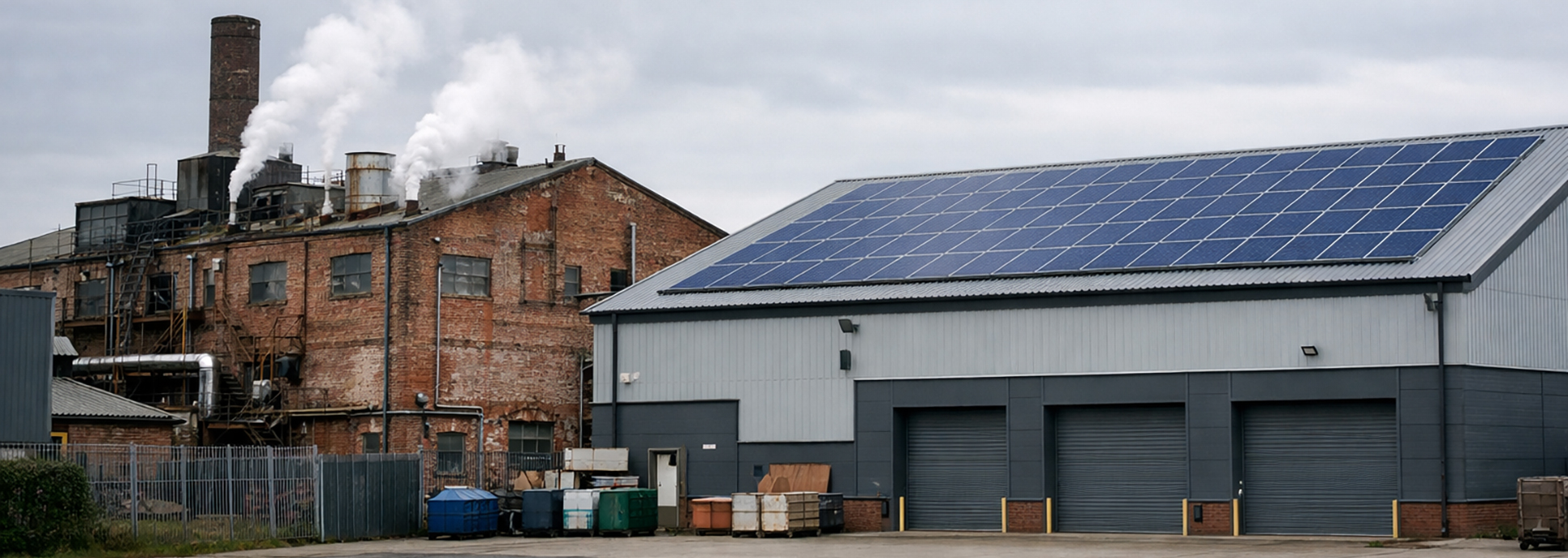
Power began with movement and force
Long before electricity became widely available, power meant movement. Water turning a wheel. Steam pushing a piston. Energy was something physical, visible, and often noisy. Early systems depended on location as much as technology. A river with a steady flow could drive machinery for decades. A boiler could power an entire operation, but only with constant fuel and attention.
These systems worked because they converted natural forces into motion. That motion was then transferred through shafts, belts, and gears. It was direct and mechanical. There was very little separation between energy production and energy use. They were effectively the same process.
Steam changed scale but not the principle
Steam power allowed energy to be generated where it was needed rather than where water happened to flow. That was a major shift. Coal could be transported, boilers could be built, and power could be scaled up in a controlled way.
Yet the principle remained similar. Heat produced pressure. Pressure created motion. Motion drove machinery. Efficiency depended on fuel quality, maintenance, and operator skill. Losses were common. Systems required constant supervision. It worked, but it was never simple.
Electricity separated generation from use
The arrival of electrical power marked a turning point. Energy no longer needed to be used at the exact point it was created. It could be generated elsewhere and transmitted over distance. That single change reshaped everything that followed.
Power stations could be built where fuel and infrastructure made sense. Electricity could then be delivered to homes, businesses, and industry as required. Instead of shafts and belts, cables and transformers took over. The visible complexity reduced, even as the underlying systems became far more advanced.
Centralised generation and the national system
As electricity demand grew, generation became more centralised. Large power stations, often coal-fired, supplied vast areas. Later, gas and nuclear added to that mix. The national grid connected these sources, balancing supply and demand across regions.
This created reliability at scale. Power became something that could be expected rather than managed locally. For many users, generation became invisible. The focus shifted from producing energy to simply consuming it.
The shift towards renewable sources
More recently, the direction has started to change again. Renewable sources such as wind and solar do not rely on fuel in the same way. They depend on conditions, sunlight, wind patterns, seasonal variation. That introduces a different kind of challenge.
Instead of steady output, generation can vary throughout the day or year. Managing that variation has become a central part of modern energy systems. Storage, grid balancing, and flexible demand all play a role.
Solar power and distributed generation
Solar represents a return, in some ways, to local generation. Not mechanical this time, but electrical. Energy is produced where it is used, often on rooftops or open land. The difference is that it integrates into a wider system rather than operating in isolation.
Electricity generated during the day can be used immediately, stored, or exported. The boundaries between producer and consumer have started to blur. That is a notable change from the purely centralised model that dominated for decades.
Nuclear and large-scale stability
Alongside renewables, nuclear power continues to provide large-scale, consistent output. It does not depend on weather conditions and can operate continuously. In a system that increasingly includes variable sources, that stability has a role.
The overall picture is not a replacement of one system with another. It is a combination. Different sources, each with their own strengths and limitations, working together to meet demand.
A system still evolving
Power generation has never stood still. Each stage has built on what came before, even when the underlying technology changed completely. Mechanical systems gave way to electrical networks. Centralised generation is now being complemented by distributed sources.
What is clear is that energy is no longer a single method or location. It is a system of interconnected approaches, balancing reliability, efficiency, and availability. The move from steam to solar is only one part of that wider shift, and it is still ongoing.